Kuwait’s Doha SWRO II contract is useful to membrane buyers for a simple reason: it is large enough that small design assumptions become expensive operating decisions. WABAG announced on August 25, 2026 that it had signed the contract for the Doha seawater reverse osmosis plant and recarbonation system, Stage II. The order had been awarded in June by Kuwait’s Ministry of Electricity, Water & Renewable Energy.
The announced capacity is 60 million imperial gallons per day, or approximately 272,000 cubic metres per day. WABAG and Kuwait’s Heavy Engineering Industries & Shipbuilding Company will deliver the project through an unincorporated joint venture under a design-build-operate arrangement. Construction is scheduled for 36 months, followed by five years of operation and maintenance. WABAG also says on-site solar photovoltaic systems will provide part of the plant’s energy.
Project status and independence note: OVAY Hydro is not affiliated with WABAG, HEISCO, Kuwait’s Ministry of Electricity, Water & Renewable Energy or the Doha SWRO II project, and does not claim to supply it. Public information does not identify the membrane manufacturer, element count, train layout or final process design.
The Contract Says More Than the Capacity Number
A 272 MLD headline attracts attention, but the delivery model may matter more to equipment and membrane suppliers. Under a design-build-operate contract, the party responsible for design and construction also has to live with operating performance for a defined period. Membrane price still matters, but so do normalized flow, cleaning frequency, replacement rate, energy demand, technical support and consistency between production lots.
That changes the quality of a procurement discussion. A nominal data-sheet value is not enough. The project team needs evidence that an element can operate inside the real feedwater envelope and continue to meet the permeate requirement after seasonal changes, fouling pressure and cleaning cycles.
Five Questions an 8040 SWRO Buyer Should Ask
1. What seawater must the membrane actually treat?
Gulf seawater is not represented by one standard salinity or temperature. A design basis should define the expected minimum, average and maximum temperature; total dissolved solids; pH; boron; alkalinity; suspended solids; organics; biological activity; and relevant hydrocarbon risk. Intake location and seasonal events can materially change pretreatment duty.
Standard membrane test conditions are useful for quality control, but they do not predict a plant by themselves. Projection work must use the project’s own water analysis and product-water targets.
2. Can pretreatment remain stable through difficult seasons?
Open seawater intakes can expose an RO plant to algae, colloids, silt and biological material. DuPont’s current technical manual notes that open-intake seawater can cause membrane biofouling when prevention measures are inadequate. The practical membrane question is therefore inseparable from coagulation, clarification or flotation where applicable, media or membrane filtration, cartridge protection and oxidant control.
Buyers should request the expected feed turbidity and silt density index at the RO inlet, not only the raw-water average. A membrane selected around optimistic pretreatment data may require more frequent cleaning and lose useful life even if its initial salt rejection looks good.
3. How are flux and recovery balanced?
Higher design flux can reduce installed membrane area, while higher recovery can reduce intake and pretreatment flow. Neither is free. As recovery rises, the concentrate becomes more saline, osmotic pressure increases and scaling risks can become harder to manage. DuPont describes typical seawater system recovery in the 40 to 50 percent range, while stressing that actual limits depend on pressure, energy, salinity and product-water requirements.
For a plant of this size, membrane count should not be guessed from capacity alone. A defensible calculation needs train availability, vessel loading, design flux, temperature correction, recovery, permeate quality and fouling allowance.
4. What is the energy cost at the required water quality?
SWRO energy is shaped by feed salinity, operating pressure, pump efficiency, pressure drop, membrane permeability and the energy recovery system. Solar generation can offset part of the facility’s electricity demand, as WABAG plans at Doha, but it does not remove the need for efficient hydraulic design.
A meaningful element comparison should look at projected feed pressure and specific energy under the same conditions. Comparing two membranes at different assumptions creates a neat spreadsheet and a poor purchasing decision.
5. What will be measured during the O&M period?
Long-term performance should be evaluated using normalized permeate flow, normalized salt passage and normalized pressure drop. Raw daily readings are affected by temperature, salinity and operating rate. Without normalization, a plant can mistake seasonal change for membrane deterioration or overlook a genuine fouling trend.
The supply agreement should also address element test records, lot traceability, storage conditions, preservation, cleaning compatibility, warranty limits and the process for investigating an out-of-family element.
Where Recarbonation Fits
The announced project includes a recarbonation system. SWRO permeate has low mineral content and typically requires post-treatment before distribution. Recarbonation and mineral adjustment can improve stability, alkalinity and acceptability of the finished water. This is a reminder that membrane permeate is not the end of a municipal desalination process; the product must meet the distribution and drinking-water requirements set for the project.
A Practical Qualification Package
Before an EPC contractor or operator shortlists an 8040 SWRO element, the supplier should receive enough information to make a testable recommendation. At minimum, that package should include:
- Complete feedwater analysis with seasonal ranges.
- Intake and pretreatment description, including RO inlet turbidity and SDI targets.
- Required permeate flow, conductivity, TDS and boron limits.
- Design recovery, train availability and proposed pressure-vessel loading.
- Minimum and maximum operating temperature.
- Cleaning chemicals, pH limits and expected clean-in-place practice.
- Reference element and normalized operating history for replacement projects.
- Required certificates, test records, quantities and delivery schedule.
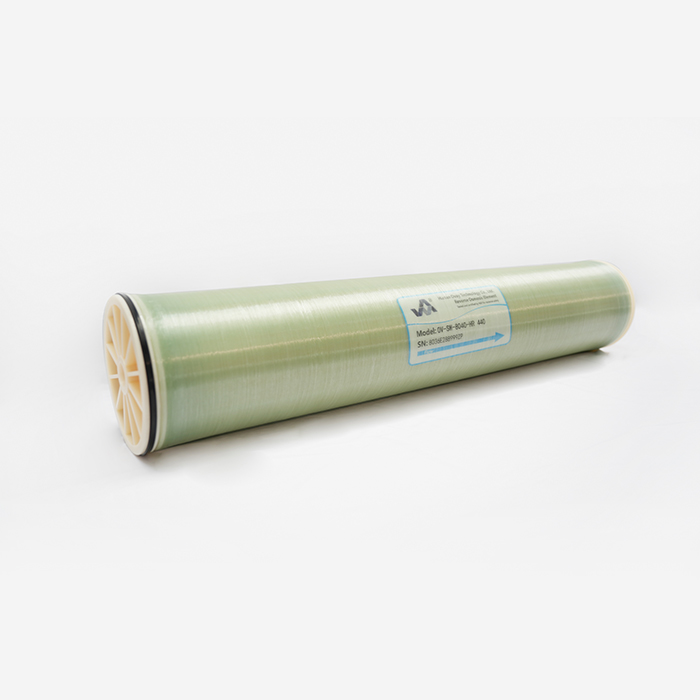
OVAY’s OV-SW seawater RO platform and 8040 membrane range are available for independent technical evaluation. Selection should be based on the project’s feedwater, permeate target and validation plan; this article does not state or imply that an OVAY product has been selected for Doha SWRO II.
Request an 8040 SWRO Qualification Review
The Procurement Lesson
Doha SWRO II is a major addition to Kuwait’s desalination program, but its broader lesson is familiar. Large plants do not succeed because of one impressive membrane number. They succeed when intake, pretreatment, membrane design, energy recovery, post-treatment and operating discipline are treated as one system.
For an 8040 membrane buyer, the best starting point is not a price request with no water analysis. It is a controlled design basis that allows competing elements to be compared under the same conditions and verified before full-scale procurement.
Sources and Further Reading
This draft was prepared from the referenced industry updates. Please review each source before publication.