Indonesia has announced a significant new seawater desalination development. On August 12, 2026, Acwa (formerly ACWA Power) and Indonesia’s state-owned salt enterprise PT GARAM announced a Joint Development Agreement for an integrated seawater reverse osmosis (SWRO) and industrial salt production facility in Manyar, Gresik, East Java.
The planned project is valued at approximately USD 400 million. According to Acwa, it is designed to produce around 62,500 cubic meters of desalinated water per day and approximately 500,000 tons of high-purity industrial salt per year. The companies describe a build-own-operate structure through an Indonesian project company.
Important independence and status note: OVAY is not affiliated with Acwa, PT GARAM or this project and is not claiming to supply it. The public announcement describes a project in development under a Joint Development Agreement. It does not identify the membrane supplier, EPC contractor, final process design or procurement schedule.
What Has Actually Been Announced?
| Project item | Publicly announced information |
|---|---|
| Location | Manyar, Gresik, East Java, Indonesia |
| Current stage | Joint Development Agreement and project development |
| Estimated value | Approximately USD 400 million |
| Desalinated water capacity | Around 62,500 m3/day |
| Industrial salt capacity | Approximately 500,000 tons/year |
| Concept | Integrated SWRO desalination and high-purity industrial salt production |
| Delivery model | Planned build-own-operate structure |
This combination matters because conventional SWRO design is not only a question of making permeate. Intake conditions, pretreatment, membrane operation, energy recovery and concentrate management are connected. An integrated salt facility may create value from a stream that would otherwise remain a concentrate-management obligation, but the detailed mass balance and commercial feasibility still require project-specific engineering.
Why Capacity Alone Cannot Determine the Membrane Count
A headline capacity of 62,500 m3/day is useful for understanding project scale, but it is not enough to calculate a responsible membrane quantity. Any estimate made from plant capacity alone would hide the assumptions that determine actual performance.
Engineers would first need the full seawater analysis, seasonal temperature range, salinity, boron target, required permeate quality, system recovery, design flux, train availability, pressure-vessel loading, pass configuration and pretreatment performance. The balance between these variables determines the number of elements, the number of trains, operating pressure and cleaning frequency.
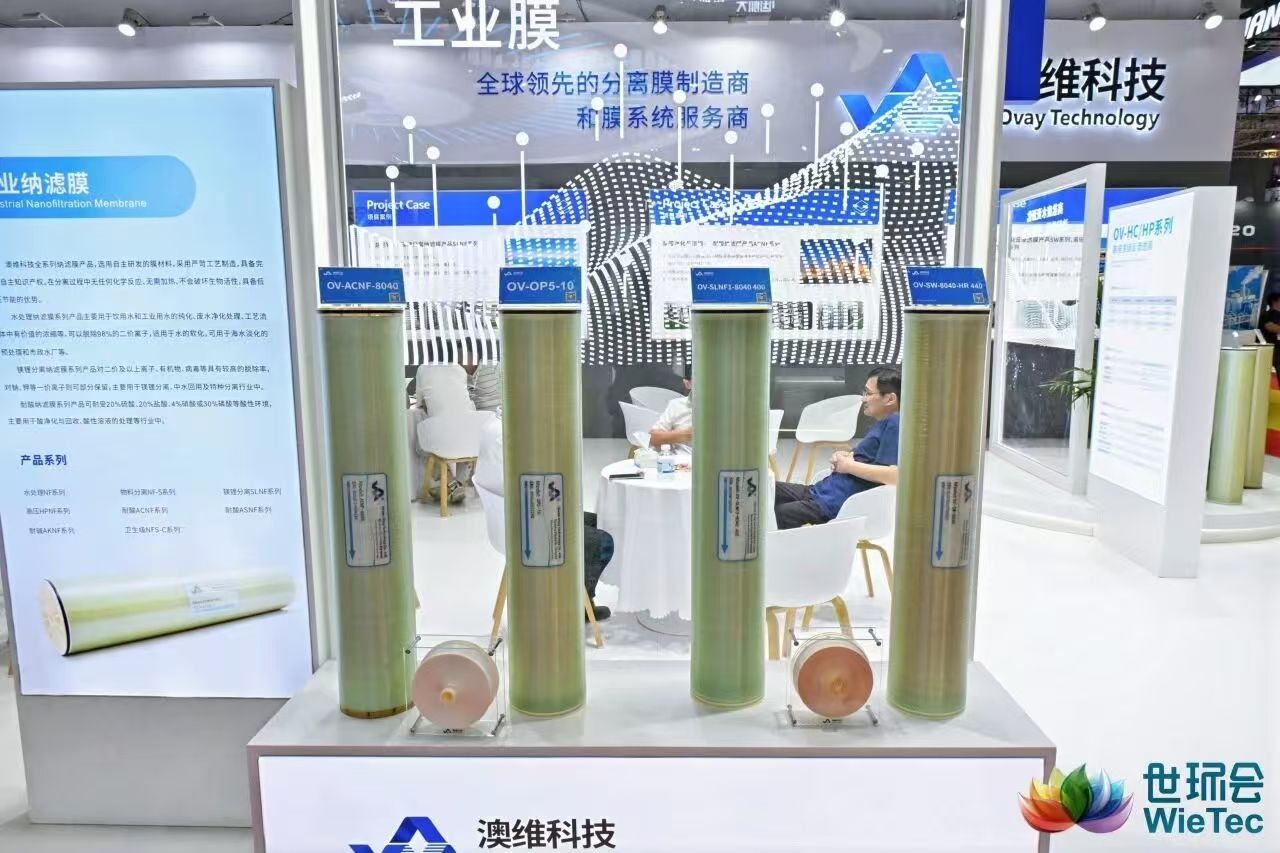
Eight-inch membrane elements are a common design class for larger industrial RO and SWRO trains, but element diameter is only the starting point. A technically useful supplier discussion should be based on operating conditions and normalized performance rather than a model-name substitution or a single nominal flow value.
Five 8040 Membrane Decisions Behind a Large SWRO Design
1. Define the Feedwater Envelope and Permeate Target
Seawater composition changes by location and season. Temperature affects membrane water permeability, while salinity and ion composition affect osmotic pressure, rejection requirements and scaling risk. Boron can become a decisive parameter where the product-water specification is strict.
Before selecting an 8040 seawater element, the design basis should state minimum, average and maximum feed temperature; total dissolved solids; major ions; boron; pH; turbidity; organics; biological activity; and the required permeate specification. A membrane that appears suitable at standard test conditions may perform differently under the project’s real envelope.
2. Match Pretreatment to Fouling Risk
Membrane performance depends heavily on the water delivered by the pretreatment system. Coastal intake conditions can introduce suspended solids, colloids, algae, organics and biological activity. Open-intake and subsurface-intake systems may therefore require very different pretreatment strategies.
The design team should define the target silt density index, turbidity, residual oxidant control, cartridge filtration and chemical-dosing strategy. Pretreatment stability is especially important for an industrial plant expected to operate continuously. A low initial membrane price cannot compensate for unstable feedwater, frequent cleaning or early element replacement.
3. Set Flux, Recovery and Array Design Together
Flux and recovery should not be selected independently. Increasing flux can reduce the installed membrane area, but it can also increase fouling tendency and make performance less forgiving. Increasing recovery reduces feedwater demand but raises concentrate salinity, osmotic pressure and scaling risk.
For an integrated water-and-salt project, the concentrate stream may be commercially important, yet the SWRO section must still operate within membrane, pressure-vessel and water-chemistry limits. The final array design should be validated with projection software and, where feedwater uncertainty is material, pilot testing.
4. Evaluate Pressure and Energy Recovery as One System
SWRO requires high pressure because the feedwater has high osmotic pressure. The membrane, high-pressure pump and energy recovery device therefore have to be evaluated as one process system. Modern energy recovery devices can transfer pressure from the concentrate stream and substantially reduce the high-pressure pump duty.
Membrane selection should compare projected specific energy consumption at the required permeate quality, not only nominal salt rejection. Feed pressure, pressure drop, permeability, fouling margin and operating temperature all affect the result over the plant’s life.
5. Integrate Concentrate Management and Salt Production
The Gresik concept is unusual because it pairs SWRO with high-purity industrial salt production. That does not mean SWRO concentrate automatically becomes a finished salt product. The downstream process must account for concentrate composition, impurities, pretreatment chemicals, concentration steps, crystallization requirements and product purity.
The official announcement also notes the potential recovery of additional marine minerals, subject to feasibility. This should be treated as a future engineering and commercial opportunity rather than an assured output. A credible design must close the water, salt, energy and chemical balances before assigning value to each co-product.
What Should an EPC or System Integrator Request From an 8040 Membrane Supplier?
For a large SWRO qualification, buyers should ask for more than a marketing datasheet. A useful technical package includes:
- Published test conditions and the method used to normalize flow and rejection.
- Element dimensions, active membrane area, feed spacer and pressure-vessel compatibility.
- Operating limits for pressure, temperature, pH, chlorine exposure and pressure drop.
- Declared flow and salt-rejection tolerances, not only nominal values.
- Chemical-cleaning compatibility and recommended preservation procedures.
- Lot traceability, factory test records and quality-control documentation.
- Samples or pilot quantities for verification under representative feed conditions.
- Production capacity, packaging, export documentation and delivery planning.
For replacement projects, the supplier should also receive the installed model, pressure-vessel configuration, operating history and normalized performance trend. Physical interchangeability does not by itself prove process equivalence.
Where the OVAY OV-SW Platform Fits
OVAY’s OV-SW seawater RO membrane platform is available for evaluation in independent desalination and industrial water projects. It should be qualified against the actual feedwater and permeate requirements of each project; this article does not claim that OV-SW has been specified for Gresik.
Engineering teams can also review OVAY’s 8040 RO membrane portfolio and quality-control process. For OEM, replacement or project supply discussions, OVAY can compare the requested operating envelope with available membrane options and identify the information still needed before a recommendation is made.
Information to Send for an 8040 SWRO Qualification Review
To receive a useful first review, provide:
- Feedwater source and complete recent water analysis.
- Minimum, average and maximum temperature and TDS.
- Required product-water flow, conductivity, TDS and boron limits.
- Target recovery and proposed single-pass or double-pass configuration.
- Pretreatment process, turbidity and SDI data.
- Available operating pressure and pressure-vessel arrangement.
- Reference membrane model, if the project is a replacement or alternative qualification.
- Estimated quantity, delivery schedule, destination country and required certifications.
Request an 8040 SWRO Qualification Review
Frequently Asked Questions
Does a 62,500 m3/day SWRO plant automatically use 8040 elements?
Large SWRO trains commonly evaluate eight-inch elements, but the public capacity announcement is not enough to confirm a final element format, model, train count or membrane quantity. Those decisions require the full process design.
Can the membrane count be calculated from the announced capacity?
Not responsibly. A defensible calculation needs feedwater conditions, design flux, recovery, train availability, vessel loading, temperature, permeate targets and safety margins.
What is the first step when comparing an alternative 8040 SWRO membrane?
Start with a controlled side-by-side technical comparison using the same test conditions. Then confirm dimensions and operating limits, run a project projection and use sample or pilot validation when the risk or project scale justifies it.
Conclusion
The planned Gresik facility is noteworthy because it connects industrial water security, SWRO desalination and domestic industrial salt production in one development. For membrane buyers, however, the most useful lesson is disciplined qualification: define the water, define the product, verify pretreatment, model the complete system and compare suppliers under equivalent conditions.
That approach creates a stronger basis for 8040 membrane procurement than relying on a project headline, nominal datasheet value or model-name cross-reference alone.
Sources and Further Reading
This draft was prepared from the referenced industry updates. Please review each source before publication.
- Acwa: Acwa signs joint development agreement with PT GARAM for Indonesia's first utility-scale integrated seawater desalination and industrial salt project (August 12, 2026)
- DuPont Water Solutions: FilmTec Reverse Osmosis/Nanofiltration Membranes Technical Manual, Version 20 (August 2026)
- DuPont Water Solutions: Industrial Water Treatment, Reverse Osmosis Systems and Configurations (Accessed August 22, 2026)