The QuenchSea SW1708 RO membrane is a compact seawater reverse-osmosis element sold for the QuenchSea 3.0 hand-powered desalination device. Its application is interesting to membrane engineers because it combines high-pressure seawater duty with a small replaceable cartridge and a manually powered system. For equipment brands considering a similar portable product, however, a model name and an advertised flow rate are not enough to define an OEM membrane specification.
Trademark and independence notice: QuenchSea and SW1708 are trademarks or product identifiers of their respective owner. OVAY Hydro is not affiliated with, endorsed by, or an authorized supplier to QuenchSea. This article is an independent technical discussion for OEM development and specification review. It is not an announcement of a compatible replacement.
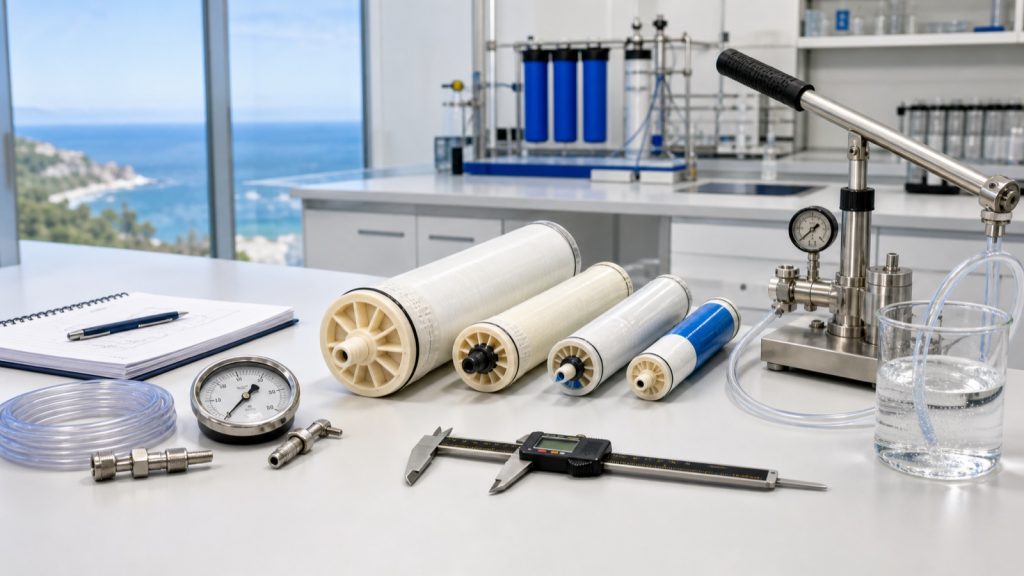
What QuenchSea Publishes About the SW1708
QuenchSea’s official product page describes the SW1708 as an advanced RO membrane for seawater only. It is sold as a two-membrane pack, carries an advertised capacity of 8 liters or 2 gallons per hour, and is stated to work only with QuenchSea 3.0. That final point matters: the manufacturer presents SW1708 as a system-specific component, not a universal membrane format.
The QuenchSea 3.0 system page publishes additional operating context. It describes a manually powered desalination device with a system pressure of 5.5 MPa, a pressure-release setting of 6.0 MPa, a seawater feed flow of 20 liters per hour, and output below 1,000 TDS. The same page lists desalination capacity at 4-6 liters per hour and salt rejection at 98%, varying with salinity. Its current user manual describes approximate output of 6-8 liters per hour and explains that salinity, temperature, pumping speed, user effort, filter condition, membrane condition and seawater cleanliness affect actual production.
These figures are system-level statements rather than a complete membrane data sheet. The different published output ranges also show why an OEM buyer should request one controlled test method before comparing candidate elements. A membrane cannot be responsibly evaluated from an hourly output claim unless feed salinity, temperature, pressure, recovery and membrane area are known.
Why a Compact Manual SWRO Element Is a System Component
A portable hand-powered desalination membrane works inside a tightly coupled hydraulic system. The pump, pressure-relief setting, pre-filter, membrane housing, seals, concentrate restriction and operator cycle all influence water production and effort. Changing one component may alter pressure, flow, recovery, permeate quality or mechanical loading elsewhere in the device.
For this reason, a compact seawater element should not be selected by appearance. Even when two cartridges have similar outside dimensions, they may differ in active membrane area, feed spacer, permeate carrier, center-tube design, end geometry, brine seal, flow direction or pressure tolerance. A consumer who owns a QuenchSea 3.0 should follow QuenchSea’s current manual, which instructs users to use approved QuenchSea replacement membranes. An OEM development program is a different process: it begins with the equipment owner’s engineering requirements and proceeds through controlled validation.
Ten Inputs Needed for an OEM SW1708-Type Evaluation
- Controlled drawings. Provide cartridge length, outside diameter, center-tube dimensions, end-cap interfaces, seal locations and tolerances.
- Housing and flow path. Define feed entry, concentrate exit, permeate connection, installation orientation and any adapters.
- Feed-water envelope. State salinity range, temperature range, turbidity limits and prohibited contaminants.
- Operating pressure. Separate normal membrane pressure from pump limits and pressure-relief settings.
- Target performance. Define permeate flow, salt rejection, recovery and acceptable variation under one stated test condition.
- Operator input. For a manual device, document pump displacement, stroke rate and expected effort across the operating range.
- Pretreatment. Specify filter rating, replacement interval and the condition of water reaching the membrane.
- Cleaning and storage. Define flushing, preservation, shelf-life and chemical restrictions for marine and emergency use.
- Mechanical durability. Set pressure-cycle, vibration, transport, leakage and seal-retention test requirements.
- Market documentation. Identify destination countries, labeling, traceability, safety instructions and certification requirements.
Performance Must Be Compared Under the Same Conditions
Seawater RO performance is highly sensitive to feed salinity and temperature. Colder or more saline water generally requires more pressure for a given permeate flow, while fouling or blocked pretreatment can increase operator effort and reduce output. A candidate membrane should therefore be compared with the reference element on the same test rig, using the same feed batch, temperature, pressure, recovery and sampling method.
A responsible validation plan records feed conductivity, permeate conductivity, concentrate conductivity, pressure, temperature, feed flow, permeate flow and test duration. It should also include repeated pressure cycles, restart behavior after storage, leak inspection and post-test integrity. Drinking-water suitability cannot be concluded from TDS alone, so equipment instructions must address source-water restrictions, hygiene, flushing and appropriate water-quality verification.
How OVAY Can Support a Portable Desalination OEM Project
OVAY manufactures reverse-osmosis membrane elements and accepts engineering inquiries for custom compact seawater RO development. For a new portable desalination product, the practical route is a controlled OEM specification rather than an informal cross-reference. The project can include membrane format review, sample construction, agreed test conditions, private labeling, packaging and lot documentation.
Buyers developing their own equipment can review OVAY’s seawater RO membrane platform, OEM membrane process and quality-control framework. These pages describe manufacturing capabilities; they do not establish interchangeability with the QuenchSea SW1708.
What to Send for a Feasibility Review
An equipment manufacturer requesting a compact SWRO feasibility review should send a physical reference sample where legally permitted, complete drawings, housing details, system flow diagram, feed-water range, pressure profile, target output, rejection requirement, test protocol, annual volume and destination market. OVAY can then determine whether a custom candidate is technically realistic and what prototype testing is required.
For OEM development inquiries, contact OVAY Hydro with the project information above. Owners seeking a replacement for an existing QuenchSea 3.0 unit should use the approved QuenchSea SW1708 specified by the system manufacturer unless QuenchSea provides different written guidance.
Sources and Further Reading
This draft was prepared from the referenced industry updates. Please review each source before publication.